Sunday, 30 March 2014

Species of the Day: Pistol Shrimp (Alpheidae)


  The Pistol shrimp are a group of small caribbean crustaceans which are part of the snapping shrimp family. Alpheidae tend to live in colonies and most live in warm costal systems, though some live in highly specialized environments such as freshwater caves.
Pistol shrimp dig down into sediment, where it forms burrows from which to launch its characteristic predatory attacks. 
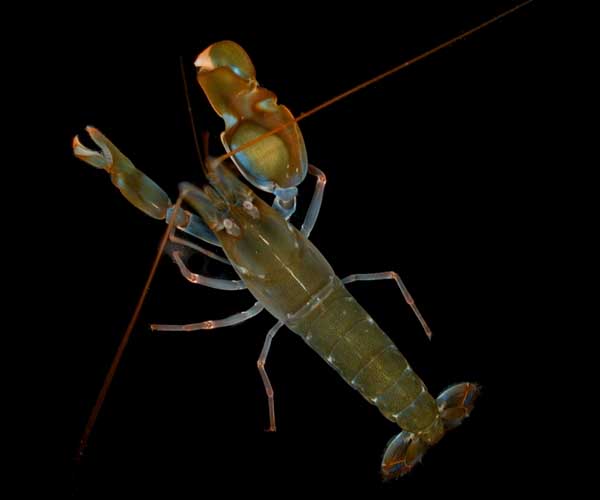
(note the distinctly enlarged right claw)


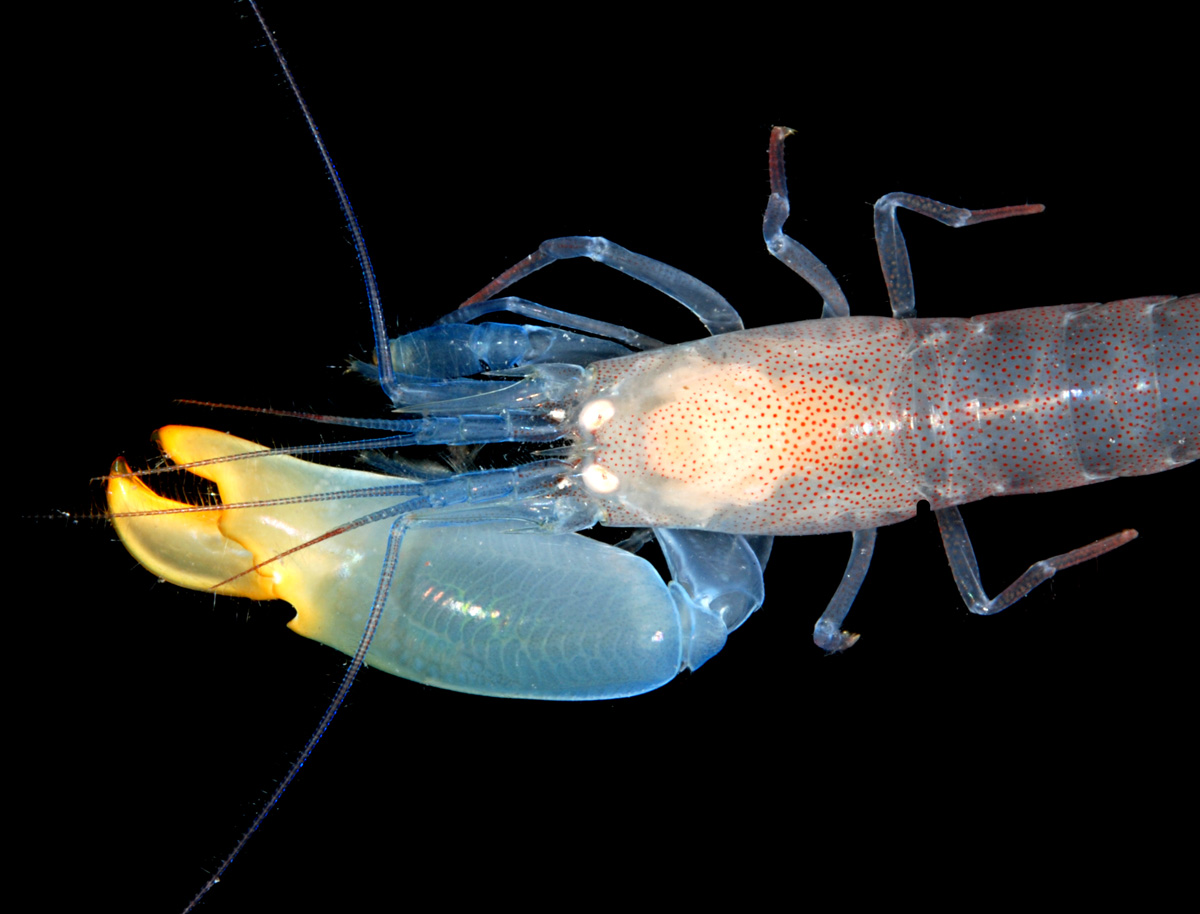
  Pistol shrimp distinctive because of the disproportionately large claw on only one side of its body. Unlike most shrimp, this claw doesn't have pincers, but rather has a very special apparatus from which its name is derived. The large claw functions much like a gun. The hammer portion of the claw is pulled into a a cocked, right angle position. When snapped downwards the hammer contacts the other portion of the claw (much like an anvil). When the hammer and anvil contact, a pulse of bubbles is shot from the end of the claw with enormous force, generating a shock wave powerful enough to kill small fish or break glass jars! Because of this snapping effect, Alpheidae competes with sperm whales and beluga whales for the loudest creatures of the sea!


  In their coral reef habitat, pistol shrimp are known to have a symbiotic relationship with gobi fish who share their burrows. The shrimp maintains the burrow for both inhabitants while the gobi fish provides protection by spotting potential threats. The shrimp communicates with the fish using its antennae while the fish communicates using a distinctive tail movement. 


The video below does an amazing job of illustrating this incredible predatory toolset!


Monday, 17 March 2014

Species of the Day: Giant golden-crowned flying fox (Acerodon jubatus)

In Queensland we are pretty used to hearing the chattering of flying foxes by night, seeing them swoop underneath street lights and burst from dark trees as we walk too close. Today I thought I would cover a different species of flying fox facing extinction in the Philippines.


Acerodon jubatus is endemic to the forests of the Philippines. The giant golden-crowned flying fox is immediately recognisable by its massive wingspan (1.5-1.7m / 4'11"-5'7"!!) and the bright golden fur on top of their heads, contrasting the black fur of the rest of their bodies.


Like other flying foxes, Acerodon jubatus lives almost entirely off of fruits. The giant golden-crowned flying fox enjoys figs particularly, but is known to eat many types of fruit as well as cultivated varieties (though this is rare). In the Philippines they are known as "Silent Planters" because they help spread many varieties of fruit seeds in their droppings. This is an example of how important they are to local ecology and how their disappearance could disrupt rainforest cycles.


Acerodon jubatus is largely endangered because of poaching and habitat destruction, much of which is done in the name of agriculture. Although conservation programs are under way, it is very difficult to conserve this species as so little is known about them. However, there are captive breeding programs being instituted and lands in Subic Bay (57 km2) being protected in order to allow this species to recover. The organisations involved include: Bat Conservation International, the Wildlife Conservation Society, WWF, and the Lubee Foundation.


Wednesday, 12 March 2014

Captive Breeding Success at Durrell Wildlife Conservation Trust


Hello A.P.P.L.E.-lytes!

Way back last year I wrote a quick article about one of my favourite conservation organisations the Durrell Wildlife Conservation Trust. One of Durrell's major goals is to establish captive breeding colonies, ecosystem conservation / restoration and release into the wild. A lot of conservationists are still sceptical about the usefulness or effectiveness of captive breeding / release programs.


I pulled some interesting stats from the Durrell website which advertises their success with captive breeding. Some of their programs have had staggering effects on the species they work with in the wild.
                        

For more information about how Durrell conservation projects work, have a  peek at the Durrell Wildlife Conservation Trust Index which describes their ongoing process.

http://www.durrell.org/durrell-index/

FREE Movie Night!


Hey All!


We have our first A.P.P.L.E. event of the year planned for tonight!

Come down to the Hamon Centre (Bld. 8255 on the Gatton Campus) tonight (March 12, 2014) at 7:00pm to catch a couple free movies! We'll be watching some great David Attenborough, so who can resist!

Bring your own snacks, blankets, friends or anything else you want to watch:

Kingdom of Plants
&
Attenborough's Ark


Tuesday, 11 March 2014

Vet in the Spotlight : Dr. Mike Cranfield

Hello A.P.P.L.E.-lytes!

   As the first instalment of a new segment to the A.P.P.L.E. blog I thought I would introduce a vet, whose work I have long admired. Dr. Mike Cranfield is a Co-Director of the Gorilla Doctors - Mountain Gorilla Veterinary Project based in central Africa. The organisation's work takes place in the often turbulent area spanning Uganda, Rwanda and the Democratic Republic of the Congo. The goal of Gorilla Doctors is to provide health care on an individual basis for mountain gorillas; a role which is of utmost import as the species has dwindled down to less than a thousand individuals in the wild. 


(Dr. Mike Cranfield)

   Dr. Cranfield was born in Peterborough, Ontario in Canada. In 1977 he completed his DVM at the University of Guelph and went on to complete his residency at the Toronto Zoo. Thereafter Dr. Cranfield moved to the Maryland zoo in Baltimore, where he still operates today. Dr. Cranfield has worked in such fields as in-vitro fertilisation of primates, malaria in penguins, captive breeding of endangered amphibians and parasites in snakes. Thirteen years ago however, Dr. Cranfield decided to take his efforts to the field to better serve endangered species both in captivity and the wild. This is when he took over the Mountain Gorilla Veterinary Project


   (Dr. Cranfield on right working with a mountain gorilla patient) 

   Dr. Cranfield continues to be an inspiration to many of us aspiring to work as wildlife clinicians in the future. His approach of working with people and animals directly has proved invaluable in protecting one of the world's most endangered species: the magnificent mountain gorilla.

Below I have embedded an interview between Dr. Cranfield and Dr. Elliot Garber. This interview is an instalment of Dr. Garber's Uncommon Veterinarians Podcast.


Cheers!

Species of the Day : Jungle Cat (Felis chaus)

The Jungle Cat is the largest member of the Felis genus. Although Felis chaus is commonly known as the Swamp Lynx, this cat is not actually a member of the Lynx family. The Jungle cat has distinctively long legs and tufts on the end of its ears. It stands about 36cm tall and ranges from 50cm to 90cm long. 


Felis chaus is found ranging from Egypt to southeast asia and the Indian subcontinent where it is amongst the most common of cats. Preferring dry habitats the Jungle cat lives in savannah, dry tropical forest and reedy rivers. Ironically Felis chaus does not inhabit rain forests!
Although the Jungle cat has never been domesticated many have been found as Egyptian mummies. It is speculated they were kept as a rodent control mechanism.

Sunday, 2 March 2014

Back to Blogging!

Hello All!

Welcome back to the blog everyone. We're getting back to uni now after a long summer and we've decided to get back to blogging more regularly.  Thanks to everyone who has taken an interest in our organisation and we hope to continue to provide interesting info about wildlife, sustainability, ecology, conservation and anthropology (plus everything in between)!

For those of you on or near the Gatton campus of the University of Queensland, stay tuned for fun events. More info on that soon!

Cheers,

A.P.P.L.E. 

Thursday, 5 September 2013

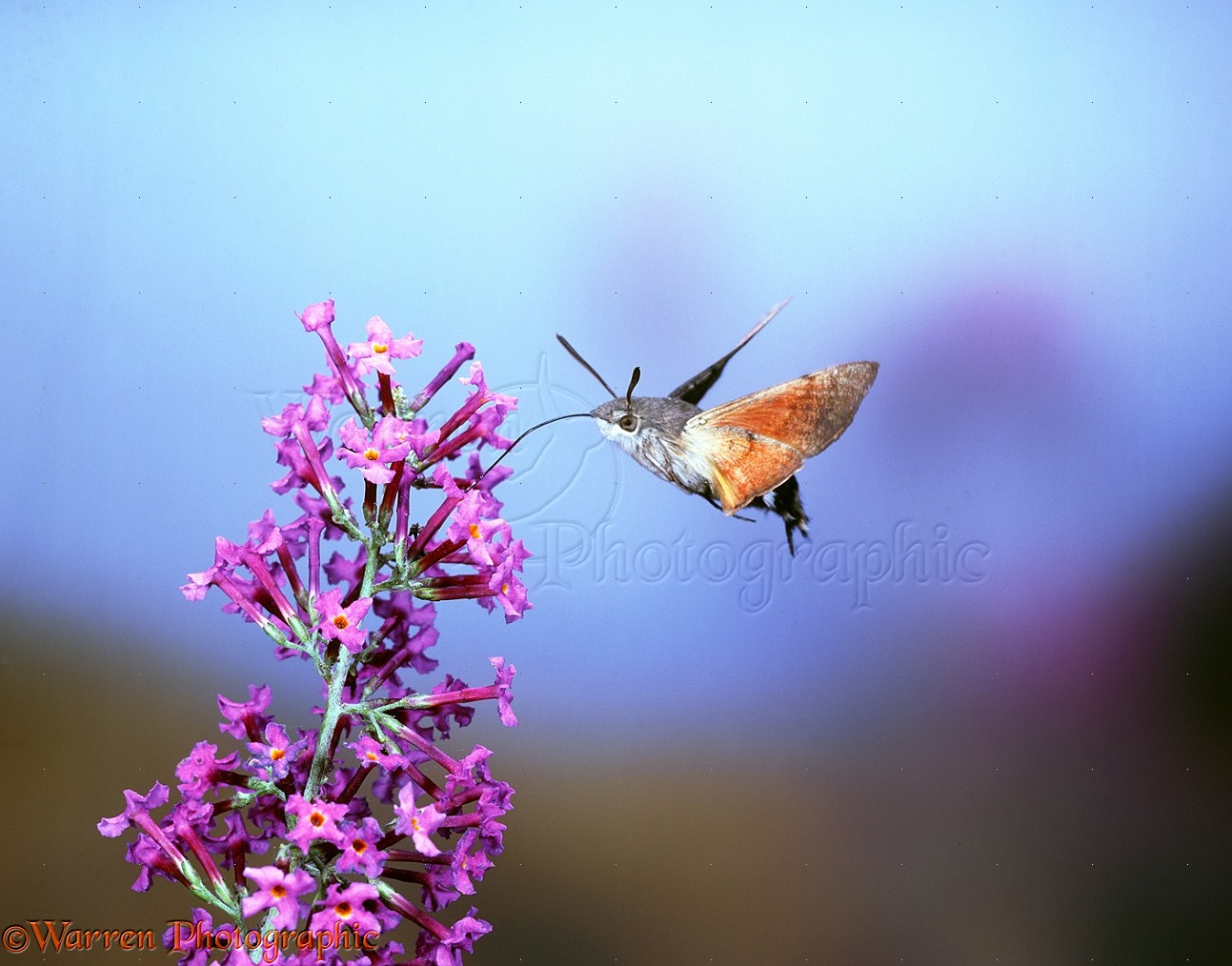
Species of the Day: Hummingbird Hawk-Moth (Macroglossum stellatarum)

Before I start this post I want to apologize for the long absence and lack of postings! This semester has proved to be more mentally draining than I expected but I'm finally getting a handle on things and am getting back in the routine of posting!


                                                    Macroglossum stellatarum

          The Hummingbird Hawk-Moth is a fascinating arthropod distributed widely from Southern Europe to North Africa and all they way to Japan. This moth is mainly remarkable for it's behaviour and morphology which make it seem incredibly similar to the hummingbird. This similarity is a wonderful example of convergent evolution, where to very disparate animals have evolved to fill the same ecological niche. This has resulted in a very similar appearance and behavioural adaptations.


                                                                vs.


                    (Above: A comparison of Macroglossum stellatarum vs. a Hummingbird.)


Macroglossum stellatarum buzzes along, much like the hummingbird drinking nectar from flowers. They also exhibit other similar behaviours to the hummingbird, such as being diurnal and returning to the same flowers, at the same time day after day. The latter behaviour allows the Hummingbird Hawk-Moth to time when a fresh nectar meal will ready after harvesting a flower. 


The above video shows the fascinating behaviour of a Macroglossum stellatarum feeding. This footage was captured in northern Europe. 

Tuesday, 28 May 2013

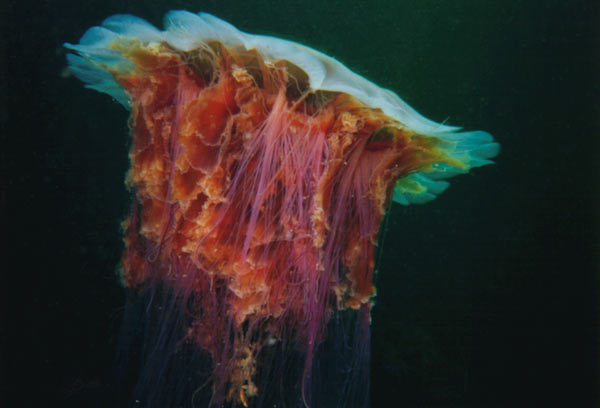
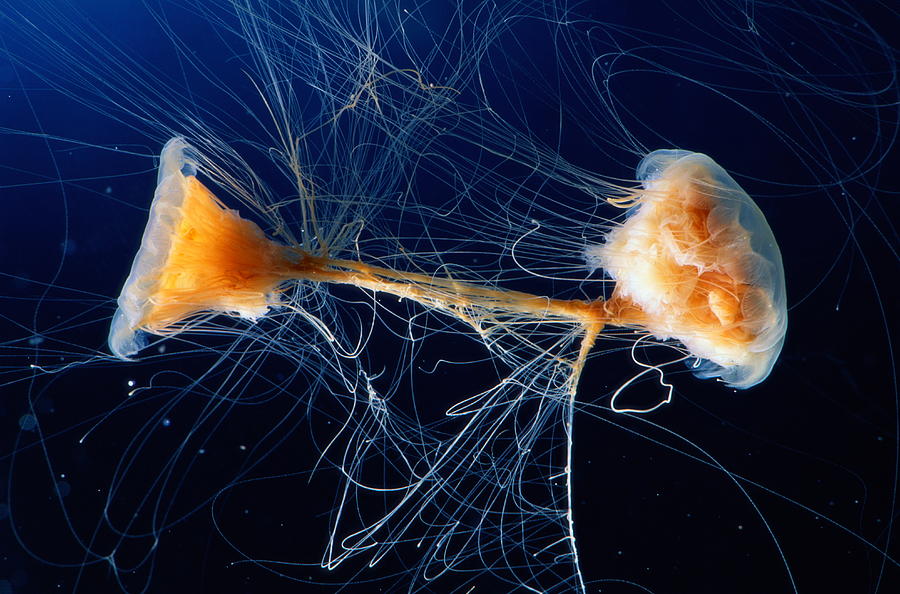
Species of the Day: Lion's Mane Jellyfish (Cyanea capillata)


The Lion's Mane jellyfish is a sea creature found predominantly in the icy north pacific, arctic and north atlantic oceans. Cyanea capillata is the world's largest jellyfish. The largest on record was found in Massachusetts Bay in 1870. That individual was larger than 7ft (2.1M) across the bell with tentacles greater than 120ft (36.5M) in length! Because of this length, Cyanea capillata is amongst the longest of all living organisms, being in competition with the Bootlace worm and the Blue Whale.


These animals are important ecologically as they act islands in the open ocean. As the Cyanea capillata floats in frosty, calm bays, many other sea creatures cluster around them, as the jellyfish provides food and shelter.


The Lion's Mane jellyfish is fed on by many large fish, seabirds and some turtles. The Leatherback Sea turtle lives almost exclusively off Cyanea capillata, travelling far and wide to reach the coasts of Eastern Canada to feed in Summer months.


Despite their massive size, the Lion's Mane jellyfish is not dangerous to humans as their sting merely causes discomfort.


Paul Nicklen's encounter with a Leopard Seal (Hydrurga leptonyx)

Check out this awesome video about Paul Nicklen who is a National Geographic photographer. This video shows his efforts to get photos of a leopard seal. The Leopard seal is a notorious apex predator which can be quite dangerous. However as this video demonstrates, the Leopard seal may also be misunderstood. Watch this short clip to see some incredible footage:


Enjoy!

Wednesday, 22 May 2013

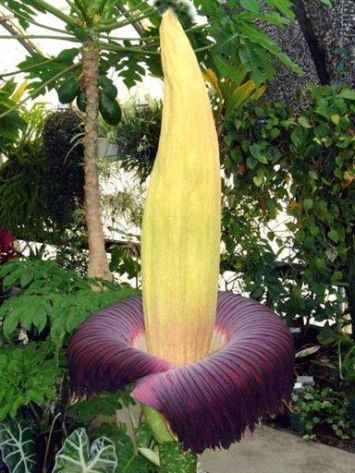
Species of the Day: Corpse Flower (Amorphophallus titanum)


Amorphophallus titanum (meaning "misshapen phallus titan") is a massive flower and is in fact the largest unbranched flower in the world. The colloquial name "Corpse Flower" comes from an odour given off by the flower which smells distinctly of decomposing flesh. This rotting smell attracts flies and therefore aids in cross pollination.


This flower grows only in the rain forests of Sumatra and holds the record for tallest flower in the world, having been cultivated to the height of 3.1 M!


Watch this clip from David Attenborough's Private Life of Plants to see the first footage of Amorphophallus titanum pollination ever.


Monday, 20 May 2013

Fruit Hunters (2012)


During my incredibly long flight from Canada to Australia I came across this Canadian documentary called Fruit Hunters, which premiered in 2012. Its an exploration of rare and exotic fruits from around the world. I was amazed by the beauty and diversity of fruit which existed in the world of which I was completely ignorant. This documentary inspired me to start hunting for new fruits myself. Fruit Hunters also makes me want to host a fruit party!!

Watch the documentary here and I guarantee you won't be disappointed!

Part I:


Part II:


Enjoy!


Sunday, 19 May 2013

Species of the Day: Gharial (Gavialis gangeticus)


This fish-eating crocodile is native to the Indian subcontinent and is found nowhere else. It is critically endangered and is undergoing a rapid decline in population. One of three crocodile species native to India, alongside the Mugger Crocodile and Saltwater Crocodile, the Gharial is one of the longer living of all crocodilian species.


(Male Gavialis gangeticus exhibiting his ghara)


Although male Gharial can grow up to 20 ft. (6 M) they are almost never any danger to humans, as they live on nothing but fish, a few frogs and insects. Male Gharial have a bulbous protuberance on the end of their snout, known as a ghara which emerges as they reach sexual maturity. The ghara is used by Gavialis gangeticus to alter his hissing noises as a breeding display. Vocalizations are very important to all crocodilians and they are the most vocal of all reptiles and amphibians other than frogs. The vocalizations of the male Gharial can be heard over a km away making it an essential breeding tool for these nearly extinct fossils. The Gharial's snout is highly specialized for hunting fish as it is so long and thin, filled with 110 razor sharp teeth! No Gharial has ever been recorded to harm humans. The myth that they are dangerous to humans comes from their habit of eating jewellery, however this behaviour aids in buoyancy regulation.


According to IUCN there has been a 96-98% decline in Gharial population since 1946. They have dropped from around 10,000 individuals down to a mere 235 (2006). The population has been stressed due to over-hunting for skins, egg stealing for consumption, slaughter for eastern medicine and culling by competing fishers.


The Gharial is a fascinating and unique species, a remnant of an age gone by. It would truly be a shame if we let this species disappear into non-existence. Check out the Madras Crocodile Bank, which is on the frontline of the fight for Gharial survival!

http://www.madrascrocodilebank.org/cms/index.php

Here is a BBC clip which shows a clutch of Gharials hatching as well as demonstrates this remarkable species' aptitude for maternal care. Enjoy:


Tuesday, 14 May 2013

Species of the Day: Lammergeier (Gypaetus barbatus)


The Lammergeier, or Bearded Vulture is a species of vulture found in a vast range of environments. Gypaetus barbatus is found in the Alps of Europe, India, Africa and Tibet. This vulture is distinguished from old world vultures by its feathered neck/head (as opposed to the bald cranial regions typical of vultures). This vulture is usually recognized by its rust red colouration, however, the adult bird is actually mostly white. The rusty colour comes from the behaviour of dust bathing. The Lammergeier is also noted for having bristle-like feathers protruding from below its beak, hence the common english name, Bearded vulture.


The Lammergeier, like most vultures, lives almost exclusively off of carrion. Unlike most vultures, Gypaetus barbatus eats almost nothing but the bones of said carrion. Because the Bearded vulture cannot break large bones into digestible chunks with its beak, the Lammergeier has developed an extraordinary technique of bone destruction.


 The Lammergeier is famous for its habit of picking up heavy bones and flying high above piles of rocks. The vulture then drops the bones from heights of 50-150m onto the rock piles, where bones too large to swallow shatter into more appropriate sizes. The Lammergeier then swoops down and devours the small chunks of bone, absorbing the nutrients in the marrow.  Gypaetus barbatus can feed on bones up to 4kg (almost half its weight!) by using this specialized technique, and this method can take young vultures up to seven years to master. Although bone marrow makes up 85-90% of the Lammergeier's diet, the vulture has also been noted to use this technique on large live animals as well.


Watch the Lammergeier using this bone scavenging technique here:


Monday, 13 May 2013

Species of the Day: Pig-Nosed Turtle (Carettochelys insculpta)


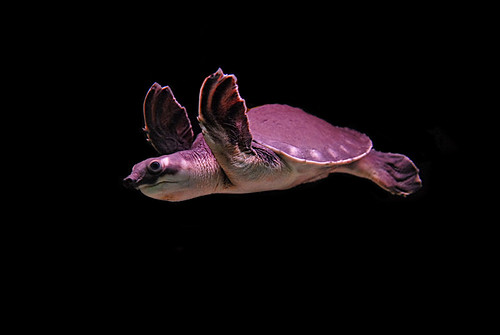
The Pig-Nosed Turtle is a freshwater turtle from northern Australia and New Guinea. The only living member of its genus, Carettochelys insculpta are unique in the world of river turtles. The Pig-Nosed Turtle, or Fly River turtle has fins instead of front feet, making it resemble a marine turtle. Carettochelys insculpta is named for its snout-like nose and front facing nostrils, which allow the turtle to take in air at the waters surface more easily.

The wild population of Pig-Nosed turtles have declined over 50% in the last thirty years for many reasons. Many are smuggled out of Indonesian New Guinea, destined for the exotic pet trade or the wildlife food markets of China.    


The Pig-Nosed turtle is an omnivore, eating fruits, vegetables, molluscs and crustaceans. Like many turtle species, Carettochelys insculpta reaches maturity late in life. Females don't reach breeding age until they are 18+ years old. This species is most remarkable for breeding strategy. They breed during the dry season and lay their eggs in sandy river banks. Remarkably the fully developed babies will not hatch until certain environmental conditions trigger the hatching process, but will rather stay in a hibernation state until ready. The Pig-Nosed turtles will only start to hatch when either the eggs are immersed in water or pressure drops significantly (signalling an approaching storm). This gives the hatchlings several advantages. Being nearly entirely aquatic, the turtles rely on the river for survival. Thus the flood induced hatching ensures the turtles will have a ready food source and also shelter in the environment they are most comfortable in. This strategy also ensures the clutch of eggs all hatch at the same time giving safety in numbers.


The following clip from David Attenborough's Life in Cold Blood illustrates this unique reproductive strategy very eloquently. Enjoy:


Sunday, 12 May 2013

Species of the Day: Golden Snub-Nosed Monkey (Rhinopithecus roxellana)


The Golden Snub-Nosed Monkey (Rhinopithecus roxellana) is a small primate endemic to the mountain forests of SW China. While the adults grow luxurious golden coats, the babies are covered in dense white fur.


 Living in frigid regions of the Sichuan province, this monkey lives mostly off of lichens. This species is endangered largely because of habitat loss. Moreover, it is because the Golden Snub-Nosed Monkey relies so heavily on lichen (which grows on trees, living and dead). When dead trees are found in the woods they are harvested by humans, thus removing a key nutritional source of this Chinese primate. 


One of the most adorable behavioural characteristics of this species is their habit of huddling for warmth while they sleep in frosty trees. The Golden Snub-Nosed Monkey lives in one of the coldest environments of a non-human primate. The following clip from Planet Earth illustrates their behaviour nicely:


Monday, 6 May 2013

Enrichment Day Success

Thanks to everyone who came out today to help us build some fun toys for the greyhounds. The staff of the clinical studies centre were very grateful and ensure us that the greyhounds will have some fun daily enrichment for the next while. Due to the success of todays meeting we will continue to have these enrichment building days in the future. Thanks again-

- A.P.P.L.E.

Sunday, 5 May 2013

Enrichment Building Day

Hey Everyone,

Dog Enrichment Building Day is upon us! C'mon down with all your recyclables to room 112/112a right beside Micks in building 8106. We'll be watching some sweet documentaries and building dog toys from about 10:30am - 2pm so come by anytime between then. See you all tomorrow,

A.P.P.L.E

Species of the Day: Regal Horned Lizard (Phrynosoma solare)


This fascinating lizard is found in the deserts of Mexico and the American Southwest. This spiky predator lives almost solely off of ants. A voracious hunter, the Regal Horned Lizard can consume thousands of ants a day and up to 2500 in a single sitting. This small lizard burrows deep in the winter to escape the cold days while it spends summer days hunting in the heat. 


To warm up in the morning the Regal Horned Lizard buries itself neck deep in the sand and circulates all its bodies blood through its head into a sack behind the eyes. The horned lizards cold blood then warms up in the head, from where it is recirculated to the rest of the body. This way the Regal Horned Lizard can warm up its body without exposing more than its heavily armoured head. 


Phrynosoma solare also uses the blood sacks behind its eyes for one of the reptile world's most amazing defence mechanism. When threatened the Regal Horned Lizard shoots blood out of its eyes up to meters away with amazing accuracy. This video (although terribly narrated) demonstrates this ability very well. Enjoy:


Wednesday, 1 May 2013

Species of the Day: Aye-aye (Daubentonia madagascariensis)


This strange Lemur hails from the kingdom of the Lemurs, Madagascar. Through the age old belief that the Aye-aye is an omen of death, coupled with recent pressures of deforestation this nocturnal lemur faces extinction. This large lemur fills the niche that a woodpecker would in North America and Europe by using it's specially adapted (elongated) third finger to probe inside trees for juicy grubs. This digit is much longer, thinner and more flexible than the other fingers.


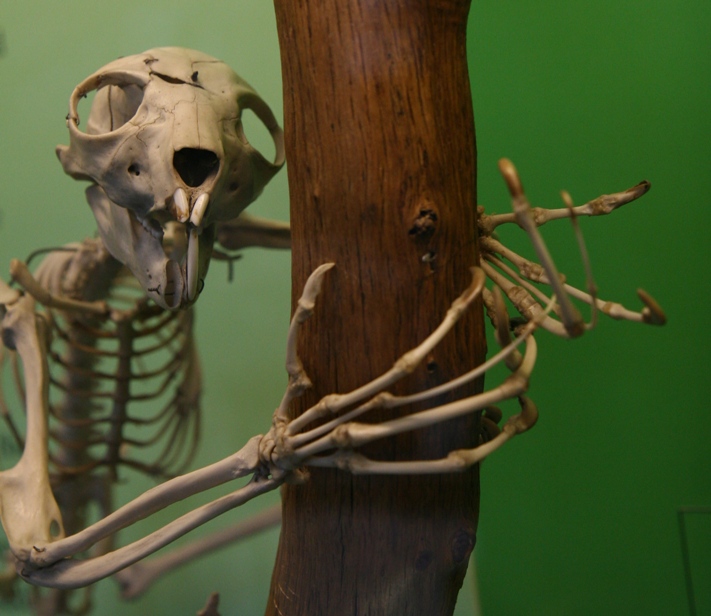
(notice the Rodent-like teeth and thin, elongated 3rd digit)


For years no one knew how to classify the Aye-aye and scientists believed this primate was in fact a rodent! This was due to the Aye-aye's odd appearance and in particular it's large front teeth. These teeth are very efficient at demolishing wood. In fact, the Aye-aye has been known to chew through concrete and aluminum. Another distinguishing of this lemur is that it's nipples are located beside the genitals, rather than on the chest or in the armpits like most primates. Between its teeth, digits and nipples, the Aye-aye is a rather odd primate.


This nocturnal creature spends most of it's nights (upwards of 80%) searching for grubs. To find insect larvae in trees the Aye-aye uses it's specialized third digit to tap on trees, listening for hollow cavities and movement within. When prey has been located the Aye-aye chews a hole to expose the cavity and probes inside with it's long 3rd digit. This digit is then used to extract the tasty morsel. Here is a video that shows how the Aye-aye catches it's larval prey:


The Madagascar Fauna Group (MFG) is one of many organizations working to save the many endemic and globally unique species of Madagascar. Check out their website for more information about Lemur and other animal/environmental conservation actions taking place now.